

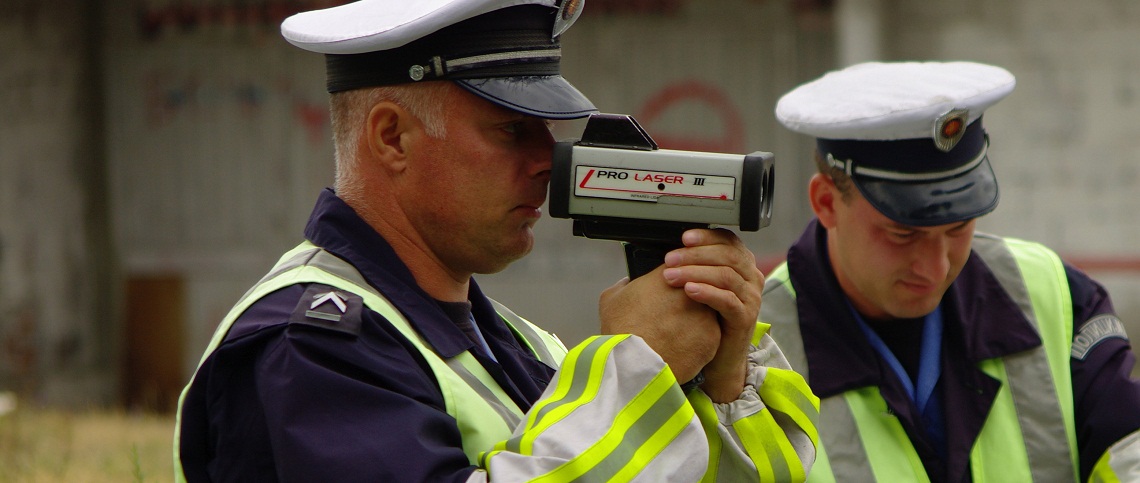

More than a half of road accidents with at least one fatality in Serbia is caused by reckless driving. Still, serious challenges are identified with the state of equipment of the traffic police in Serbia.
By Andrej Stefanović (BCSP) / Photo: Blic
Road safety is a strategic priority in Serbia and a traffic police are seen as professional, technically equipped and properly trained. However, Serbia is still a country facing a complicated situation when it comes to road safety.
More than a 6 hundred deaths happen on the roads in Serbia in 2015 or 86 deaths per 1 million population. Serbia is ranked 107th for the overall quality of infrastructure, and 99th for the quality of the road infrastructure. Only Albania and Bosnia and Herzegovina performing worse in both categories in the region. Serbia lags behind the European Union average in the number of road traffic deaths and is significantly behind countries with the best performance in road safety, such as the United Kingdom, Sweden, and Netherlands.
Despite the strategic commitment to improving road safety and obvious problems that exist in this regard, the Ministry of Interior of the Republic of Serbia (MoI) has not done much when it comes to upgrading the state of traffic police, especially its local units. The new study by the civil society organization from Serbia Bečej Youth Organization on the purchase of a radar for the traffic police in Alibunar municipality indicated significant shortcomings.
The Ministry of Interior of the Republic of Serbia (MoI) does not plan to purchase radars. In the MoI’s procurement plans, only purchasing of safety vests and video road surveillance systems can be detected, without mentioning of procurement of radars, which are of utmost importance considering the fact that as much as 53% of road accidents with at least one fatality in Serbia is caused by reckless driving. This poor procurement system for the traffic police can be connected with the absence of any kind of internal regulation on the detection of needs of various units of traffic police and on the planning of relevant procurement.
Serious challenges are identified with the state of equipment of the traffic police in Serbia. In the absence of MoI’s involvement, local units of the traffic police turn to local authorities for funds. Even though the role of local authorities appears to be legal, practical problems arise since these demands create financial burdens on them. A large portion of funds acquired through traffic fines are directed to the MoI, and only a smaller amount belongs to the local authorities. Local authorities are first and foremost entrusted with funding educational programs in the area of road safety, for all participants in traffic. Finally, it is questionable whether local authorities possess sufficient specialized knowledge in order to properly carry out procurement of traffic police equipment.
Confirmed by Alibunar Municipality
Above mentioned problems are confirmed in the analysis of the procurement of a radar for the traffic police in Alibunar municipality.
Even though Alibunar local police unit sent requests for radar procurement, the MoI did not respond. In this situation, the local traffic police were forced to transfer its demands to the local authorities, which initiated a procurement procedure for this piece of equipment.
The local commission for this public procurement had a hard time in defining technical specificities of the radar, something which created suspicion whether the principle of competition and equality among bidders was honored. As a result, there was only one bidder, even though many other producers expressed their interest in participating.
Problems in the planning process can be viewed when it comes to the assessed price of the procurement, which ended up a lot higher than the actual price offered by the bidder. This kind of discrepancy creates the basis for the offered price to be marked as an unusually low price.
When it comes to the effectiveness of the procurement, even though the radar contributed to significantly more traffic violations to be handed out, the number of traffic accidents remained approximately the same in the period after the procurement.
This unfavorable procurement performance serves as a warning of what types of irregularities can occur when there is no proper practical fulfillment of strategic commitment in the field of road safety.
There is a need to adjust the procurement for traffic police in accordance with the existing legislative framework, where the primary responsibility should be on the MoI. In order for the MoI to recognize the shortages of local units, there needs to be an improvement in the communication between the two. On the other hand, local authorities should mainly be entrusted with educational activities.
The assessment of radars procurement was done by Bečej Youth Organization, the member of the PRO-CURE network of civil society organizations, which aims at improving the performance of public procurement in the security sector through facilitating more economic, efficient and effective public spending.
Civil society organizations
dedicated to oversight of police integrity.