

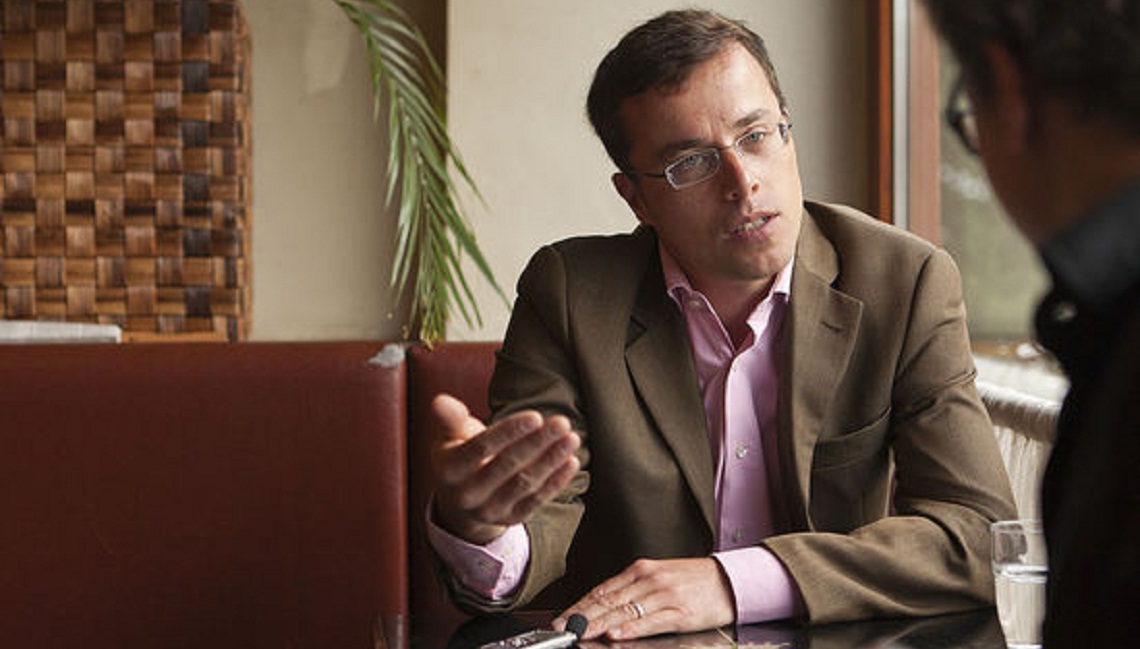

The biggest challenge for transitional countries in creating accountable police are officers who are used to the “old way” of doing things, underlines anti-corruption expert Tilman Hoppe.
By Saša Đorđević (BCSP) / Photo: Tilman Hoppe (©Bundestag)
@Bambayay
Tilman Hoppe is an anti-corruption expert who has worked as a judge in civil and criminal matters. For four years, he was a team leader at a financial firm reorganising a corrupt state-owned bank in Berlin, and after that Hoppe worked for three inquiry committees of the German Parliament. Since 2011 he has been a Long-Term Advisor for the Council of Europe’s anti-corruption project in the Eastern Partnership region. The POINTPULSE met him at the workshop in Podgorica, Montenegro, and arrange interview on different police integrity issues.
— Let start with a basic question. In your opinion, what are three main conditions for creating police service with integrity?
It depends on which country you are talking about. In a country with a serious corruption problem in the police, you need first of all leadership that wants to address the issue seriously. You also need to have prosecutors and courts you can rely on, in case you want to hold corrupt public officials accountable. And you need a civil society who wants a police service with integrity, who is willing to exert the necessary political pressure, and who has the capacity of doing so.
— You have a lot of experience with anti-corruption reforms in transitional countries and regions, like the Western Balkans, Azerbaijan, Ukraine, and Moldova, for example. What are the challenges for transitional countries in the process of creating accountable police?
Officers who are used to the “old way” of doing things. They do not want to lose the extra income and the extra power. And they often infect younger newcomers. They also make it hard for non-corrupt officials to enjoy their job, as they ruin the image of the entire service.
— Although more than half the citizens of the Western Balkans have confidence in the police, this institution is simultaneously also considered deeply corrupt, about 70 percent share this opinion. What do you think about this perception and what is the current situation in Germany?
Perceptions often tend to be contradictory. However, in this case, it could make sense. Citizens know they cannot do without the police, and the police are still providing them with services, even if there is a corruption problem. Perceptions also tend to change only slowly. So while reforms may already be underway and may show results, the public at large takes the time to “digest” these changes.
In Germany, citizens perceive police corruption to be an absolute exception. There are rather rare reports in the media. The reported cases do not affect citizens directly, such as with traffic police, but are mostly about selling insider information to organised crime.

— And, what about fighting police corruption in Germany?
Civil society at large does not accept bribing police. At the same time, practically all police officers would be seriously offended if offered a bribe and would always report such offers. Civil society and police officers share the same values. Cases are thus very rare. There is no specific case statistic on police corruption in Germany. However, in 2015, there was a total of 1,000 corruption suspects in the entire public sector, so not the only police. Of these, most are related to procurement and similar issues, which is not a typical police corruption risk. Strong prosecution and an independent judiciary are also important. In 2015, the rate of successful investigations of public sector corruption ranked between 86 and 97 percent, depending on the offence.
— Currently, in the Western Balkans are undergoing reform on police internal control. According to your way of thinking, what are preconditions for establishing the internal control system?
The internal control unit needs to be independent. It needs to be staffed with people whom the leadership can trust. And it needs direct access to leadership. Most importantly, though, it needs support by a leadership that really cares about fighting corruption and at the same time manages to take at least a substantial part of the service on board for the necessary reforms. Obviously, internal control systems depend also on the larger framework, such as whistle-blower protection.
— Prevention or repression as the best solution for tackling police corruption? What do you think, what is more necessary?
If I had to choose between the two, it would be repression. There is no prevention without repression, and repression in itself is already prevention. But of course, one has to also analyse where the opportunities for corruption are, and how one can close gaps in the prevention system. As another point, one cannot separate corruption from the overall service mentality. If the service is bad, citizens will often perceive this as corruption. At the same time, a bad service mentality is the breeding ground for ethical violations.
— In the Western Balkans, integrity testing is considered as one of the main ‘weapons’ for fighting police corruption. In your view, when and why should police internal control bodies make use of this tool?
Integrity testing can be a highly effective tool in sectors rife with bribery. In Georgia, integrity tests conducted on a random selection of police officers were part of the success of eradicating rampant bribery in the traffic police within a few weeks. However, there are some preconditions.
Testing scenarios have to be realistic in order to work – if an undercover tester approaches a public official in a clumsy, obvious way, the test will not work. One needs a specialised well-trained and well-equipped testing unit. The testing unit also has to be of highest integrity and confidentiality. Corrupt officials are willing to pay a lot of money for information of the targets and timings of tests. This is why it can be a good idea to subject the testing units themselves to testing by another unit. The introduction of (random) integrity testing needs accompanying public awareness and transparency in order to gain trust for this tool.
— Also, police unions consider salary increase as one of the main measures for police corruption reduction. What do you think, in a long-term view, whether wage increases can reduce the level of corruption within police service?
I am not aware of any research so far that could establish a link between raising the salaries of public officials and lowering bribery. But it is very clear that public officials need a salary on which they and family members depending on them can live off.
For this reason, in Georgia, salaries of police officials were significantly raised (using foreign donor money). However, this was only a successful measure, since it was coupled with very tough reforms: inter alia getting rid of all officers unfit for service and conducting large scale integrity tests.
If salary raises are not embedded into effective measures like this, money alone will not achieve much on its own. People always want more money. It is, in particular, high-level public officials that are found to be corrupt all over the World, but their salaries are 50,000 or even 300,000 USD a year.
— At the end, what is the main role of civil society in fighting police corruption and what are the benefits and drawbacks of regional civil society networks?
The main role of civil society is simply not paying bribes. We should not forget that citizens often profit to a large extent from paying bribes – “I don’t need to buckle my seat-belt. If I get stopped, I just pay a small bribe and I will be let off”. In this regard, integrity tests also target citizens indirectly: police officers will suspect that any citizen could be an integrity tester, and thus will start reporting bribe offers by citizens. Then citizens will stop offering bribes because public officials start reporting them.
Ordinary citizens do not have the capacity to scrutinise cases of misconduct, analyse the legal and organisational framework of the police, and persist in making police work more transparent. Civil society organisations can take on this role. A regional civil society network broadens the exchange of experiences and can make each stakeholder stronger.
Civil society organizations
dedicated to oversight of police integrity.