

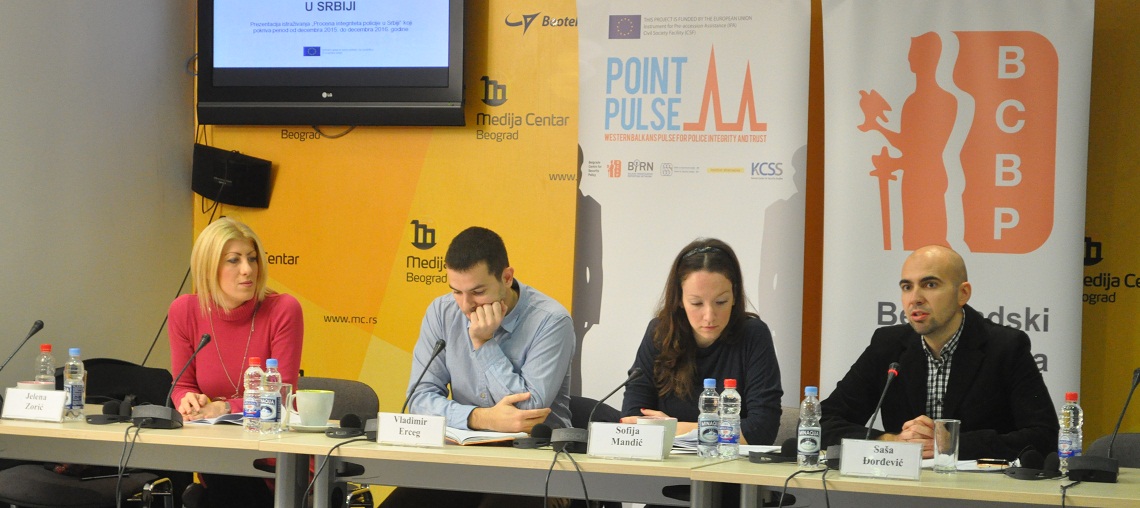

BELGRADE – The integrity of Serbian police is considerably impaired. This is reflected by the high perception of corruption among the citizens contrasted with the low number of corruption charges against police officers; extreme and growing politicization of police work; and inadequate procedures for handling citizens’ complaints.
Belgrade Centre for Security Policy (BCSP) organized a conference at the Media Centre in Belgrade on 13 December, with the purpose of presenting the report “Assessment of Police Integrity in Serbia” for 2016. The report deals with the issues of external oversight, police accountability, financial and human resources management, as well as the criminal responsibility of police officers. In addition, politicization and transparency of police work were covered in the report as horizontal issues.
Inadequate Fight against Corruption within Police
Researcher at BCSP, Saša Đorđević, stated that despite the fact that the Ministry of Interior (MoI) employs more than 40.000 people, Internal Control Sector brings an average of 130 criminal charges against police officers regarding cases of corruption on annual level. „The number of charges is low and does not correspond to the high perception of corruption within police, if taken into account that only 3% of citizens believe that there is no corruption within this institution. Additional problem is the fact that there is no information available regarding the results of criminal proceedings, “said Đorđević.
One of the crucial problems is also the fact that there is an excessive influence of politics on the operational police work, which is held as true by ¾ of the citizens based on the public opinion survey conducted in 2016.
„One of the examples of such influence is the practice of politicians publicly disseminating information from the ongoing investigations, usually in a way that is attractive for the media. This has been identified as a problem since the democratic changes in 2000. The citizens see this, as well as the civil society organizations and the EU institutions. This is why the European Commission, in its latest Country Report, recommended to the Government of Serbia to implement measures in order to secure the operational independence of police,” said Đorđević.

The “Savamala” Case
As far as the cooperation between the Ombudsman and police is concerned, the “Savamala” incident worsened the situation when it comes to the external oversight of the police conduct.
“The “Savamala” incident showcased all the systemic problems that exist within the police, as well as the fact that certain police officers are not resilient to crime and corruption. In 2014 the cooperation between Ombudsman and police was regarded as exemplary, whereas in 2016 the “Savamala” incident has worsened it to a great extent,” stated Đorđević.
He added that this was also the prime case of politicization of the police, which was a fact established by the Ombudsman’s report from the control procedure, published on 9 May 2016. Namely, the report found that the police refused to respond to citizens’ calls and did not intervene on the night of Savamala incident, claiming that this order “came from the top of police.”
In addition, no internal control of police conduct by the Internal Control Sector ever took place, although it was their duty to establish the responsibility for the inaction of police on that night.

Inadequate System for Handling Citizens’ Complaints
A researcher at the BCSP, Sofija Mandić, said that research shows that 90% of citizens’ complaints regarding police misconduct after the review procedure find that there was no infringement upon their rights. This points to the fact that the procedure for filing complaints is unclear and inaccessible to the citizens.
“The procedure is inadequate and unjust, both on the account of high percentage of dismissed complaints, as well as because the first instance in the review procedure takes place with the head of the organizational unit within the police. This person is not unbiased and tries to convince the citizens who filed the complaints that actually no breach of their rights took place,” said Mandić.
She also added that the new Law on Police, adopted in early 2016, brought many good solutions when compared to the previous one. However, a huge discrepancy is still evident among the good possibilities envisaged by the law and the actual track-record of its implementation.
The Police Budget is a Social Category
As pointed out by Vladimir Erceg, a researcher at BCSP, fulfilling the goals of maintaining public law and order is compromised by the social components of the MoI’s budget.
“Approximately 83% of the MoI’s budget for 2017 was earmarked for salaries and social benefits, around 14% for maintenance, whereas only 2.5% for equipping the police force,” said Erceg.
He also stated that the budget for the upcoming year planned a modernisation of the MoI’s vehicles, with the sum of approximately 6 million euros, despite the fact that there are already two additional projects that also envisage the procurement of new vehicles for the traffic police.
“Another great integrity risk within the police is poor procurement performance, especially in light of the fact that the funds used for this purpose are far from the actual needs. One example of bad practice was the procurement of 14.000 pairs of combat shoes for police officers, which lacked adequate specification, turned out not to be waterproof, and showed significant signs of wear-and-tear after only a couple of months of use,” said Erceg.

Parliamentary Control only Exists on the Paper
“Despite the fact that the new convocation of the National Assembly now includes an increased number of opposition parties, it did not contribute to a lively parliamentary debate nor did it enhance the Parliament’s oversight functions,” said Erceg. The research shows that the most serious concern is the situation where the Parliament’s functions are being increasingly reduced to rubber-stamping and acclamation of the executive branch of the Government.
The institute of parliamentary questions for holding the Government accountable is not often used, as the Rules of Procedure allow for the Chairman of the National Assembly to effectively provide a safe haven for the Government from being questioned by the MPs by simply not scheduling a session on the last Thursday of each month. In addition, the new powers bestowed upon the Committee on Defence and Internal Affairs by the Law on Police are not being used extensively by the MPs who are members of this committee. So far, its role has been to mainly review legislative proposals and adopt quarterly reports submitted by the MoI.
Civil society organizations
dedicated to oversight of police integrity.