


SARAJEVO — Neither legal framework, nor the practice is satisfying enough to ensure integrity of police in Bosnia and Herzegovina. It’s necessary to foster serious changes and reform within police.
By Hamza Visca (CSS) / Photo: Sanjin Hamidicevic
@CSS_BiH
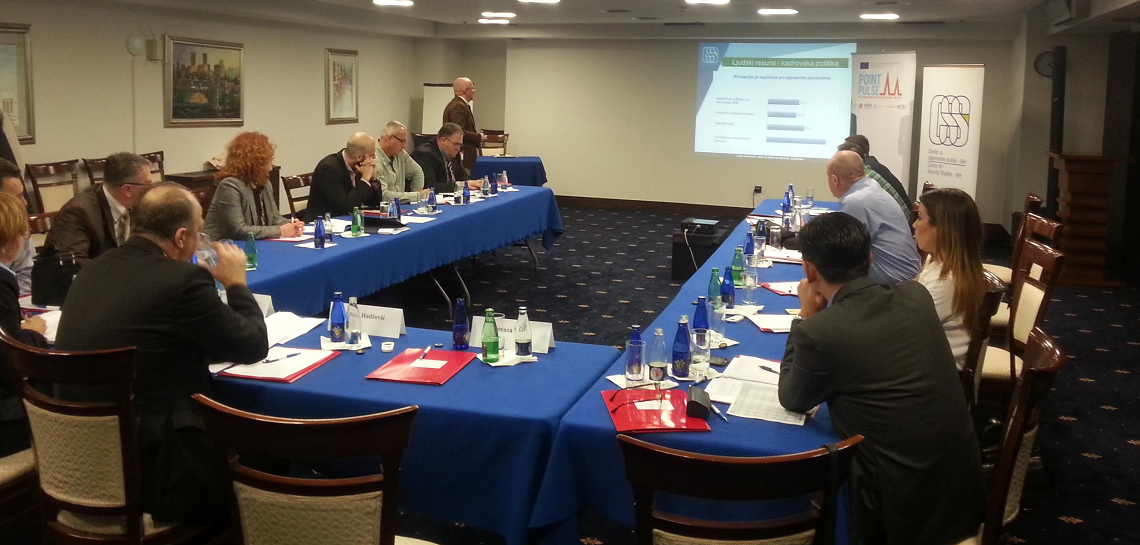
The Centre for Security Studies (CSS) organized a conference in Sarajevo on 7 of December, with the main idea to present the report “Assessment of police integrity in Bosnia and Herzegovina”. The report covered the issues of transparency, politicization of the police, human resources management, financial management, and internal and external control of police work. More than 20 representatives from internal control units of police and external control bodies attended the presentation and took part in the discussion.

The challenges of inappropriate structure
The complexity of the political structure of Bosnia and Herzegovina, defined by General Framework Agreement for Peace in Bosnia and Herzegovina, is reflected on the police structure, making it fragmented, non-effective and non-affordable. There is no subordination or any other formal operational link between 16 agencies, which are functioning on state, entities or district and cantonal levels. Reform processes regarding the structure of police apparatus were stopped at the very beginning. Visible progress was made within the police agencies, the area of cooperation being based on the political will.
Misunderstanding of transparency
The CSS researchers pointed out that the police apparatus, regarding its transparency, is acting according to the laws on free access to information, mostly on time, and with updated information. “But, we can’t be satisfied with their e-mail communication, the quality of their web sites, as well as the content and freshness of information available”, explained Hamza Visca from the CSS. For example, more than a week is needed to find the CV of the newly appointed commissioner of one cantonal police on their web site, said Visca.
In addition, police transparency is not satisfying when it comes to investigation of serious cases of corruption. The CSS noted the lack of relevant statistical data on corruption in general and on corruption in police. Mr Sado Djipa, Inspector of professional standards unit in the Ministry of Interior of Federation of Bosnia and Herzegovina, expressed high agreement regarding the necessity to harmonise the format of statistical data in police agencies, and the need to be more transparent, particularly in cases of corruption.

But, there are several cases where noticed a flood of unexpected transparency. This occurs when it comes to arrests of high-ranking officials, politicians, that are often done in the presence of the media, especially TV crews and afterwards broadcast to the public. This creates the situation that, in the eyes of the public, the arrested people are declared guilty in advance, i.e. before any trial and legal verdict. It is easy to link this behavior with political influence on police and prosecutors.
High influence of politicians on the police work
Denis Hadzovic, Secretary General of the CSS, said that there is a necessity to minimize the possibility for political influence on work of independent committees, as well as on operational functioning of police.

The public opinion survey conducted by POINTPULSE Network showed that over 80% of Bosnia and Herzegovina citizens believe that politicians have complete or a high influence on the operating work of police. “Our research finds that this is in strong link with th level of trust of the police, which is very low, as well with the level of corruption within police”, said Hadzovic.
The activities designed to formally disable political influence in the appointment and dismissal of heads of police structures, were not successful. During the reform, independent committees to carry out the process of the election of police directors and commissioners were established. At the same time the discretionary right of selecting candidates who meet the criteria was given to members of the committee. This is a moment where corruption can occur, i.e. the selection on the basis of suitability or other unprofessional criteria.
Internal and external control should be more independent
Internal control units are not fully independent in their work, as they are a part of the police body, and each head of the internal control unit is nominated by the manager of the respective police body.
In addition, internal control is not visible for public. Public opinion survey shows that 91,4% citizens of Bosnia and Herzegovina have not heard of internal control in the police. The citizens who have heard of the internal control in the police don’t know the clear purpose, mission and tasks of Internal control unit. Dalibor Santic from the Internal control unit of the Ministry of Interior of Central Bosnia Canton was surprised by these figures and concluded that the police must work more on the visibility of Internal control bodies.
Significant measures of control have been established and initiated in the process of security reform (including parliamentary control, executive control, judicial control and control by independent state bodies, such as the Office of the Ombudsman or the audit offices).
There are bodies that oversee police work only, and other which are in charge of overseeing the security sector in general, including the police agencies. If we want to achieve essential and effective control of police work and other security agencies, we need serious changes and reform, said Hamza Visca from the CSS.
Sifet Podzic, Head of the Joint Parliamentarian Committee for oversight of defence and security, said that in next period its Committee has to be more focused on monitoring, inspection and control of the building integrity processes in the military and police structures. This task will be high on the list of priorities in the next year, he concluded.
Civil society organizations
dedicated to oversight of police integrity.