


BELGRADE – The integrity of the police in Serbia has been compromised. Ministry of Interior has recognized the problem of compromised integrity of the police, and that is good.
By Dunja Tasić (BCSP) / Photo: Media Centre
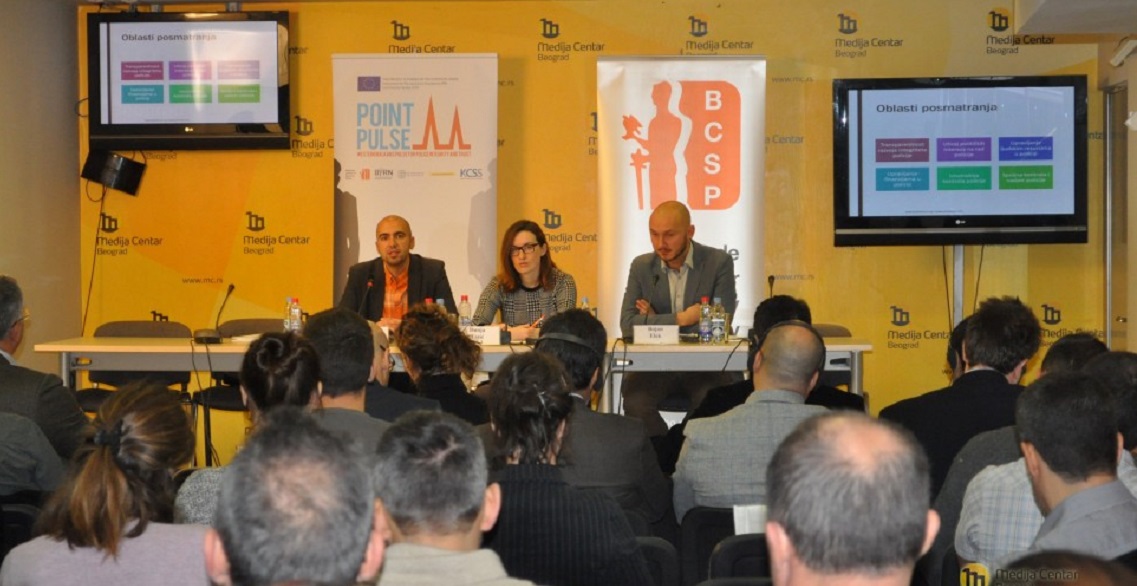
Belgrade Centre for Security Policy (BCSP) organized a conference in Media Centre in Belgrade on 26 of November, with the purpose of presenting the report “Assessment of police integrity in Serbia”, which deals with the issues of transparency, financial management, human resources, police politicization, as well as internal and external control of police work.
Troubles with human resources
BCSP researcher Saša Djordjević pointed out that the Draft of Law on Police doesn’t prescribe the obligation to select the best candidate on the internal competition for managerial position in the police, which is a bad solution. Instead, the Minister has the discretional right to choose the candidate which applied to internal competition.

Also, Minister the right to include other MOI organizational units in the work of Sector for Internal Control. Djordjević pointed out that the Draft of the Law on police brings a handful of good changes, in between which is the formation of Sector for Human Resources Management, and the fact that the Strategy of human resources development is adopted is also sound improvement.
‘The remaining problem is the fact that the graduates of Police Academy cannot get a job in the Ministry of Interior (MoI), so we can ask the question, how can their education and training be amended so it can suit MoI’s needs’, Djordjević pointed out.
When referring to internal control of the police, Djordjević said that the Sector of Internal Control doesn’t have suitable human, material and financial capacities to control the MOI employees in a proper manner.
Is MOI’s work transparent enough?
BCSP researcher Bojan Elek pointed out that MoI has the minimalistic understanding of transparency, so there is a “lot of room” for improving it. It is positive that there were five public discussions about the Draft of Law on Police, but, on the other hand, MoI hasn’t published the changes within different versions of the Law, nor has it explained why some comments were adopted and the others haven’t.

Furthermore, MoI’s website is not exactly user-friendly, but the researches of BCSP have the information that the new website is about to get launched soon. Website should be updated regularly, because it is the basic canal of communication between MOI and citizens.
When it comes to finances, Elek pointed out that one of the biggest issues is transfer from line and program budget, which still hasn’t come to life. In order to solve financial management problem, MOI has to strengthen the capacities of internal audit and ensure the implementation of its recommendations, mainly in the public procurement procedures.
External control not efficient enough
BCSP researcher Dunja Tasić pointed out that external control of police work is often more formal then essential, especially when it comes to control conducted by the Defense and Internal Affairs Committee. Its control comes down to adopting the three-month report on police work, which are not available to the public.
‘It is a good solution that the Draft of Law on police prescribes broader authority of the Committee, such as the possibility to control the usage of financial funds, implementation of special evidence measures, and other issues’, said Tasić.

On the other hand, MoI’s cooperation with the Ombudsman and the Commissioner for Information of Public Importance and Personal Data Protection, is very good. Cooperation between MoI and Anti-corruption Agency has to be improved, especially when it comes to implementation of Integrity plan, which was adopted by MoI in 2013.
The purpose of the research was to research the legal and practical circumstances which could compromise the integrity of Serbian police, as well as to answer the question whether the police actually complies with the set strategic goals. Research methods which were used are analyses of existing documents and regulations, requests for free access to public information, as well as interviews with representatives of MOI and other relevant state authorities.
Civil society organizations
dedicated to oversight of police integrity.